

Every day, businesses make decisions about physical locations.
Where should we invest? Which locations need attention? Are our marketing campaigns bringing more visitors? How can we improve accessibility, operations and performance?
These decisions are rarely simple.
A retailer may have extensive sales data but limited understanding of how activity around its stores is changing. A property owner may know how much space is available without fully understanding how people and vehicles use the surrounding environment.
The problem is not necessarily a lack of information.
It is knowing which information matters when a decision needs to be made.
This is where mobility intelligence and decision intelligence come together.
What is mobility intelligence?
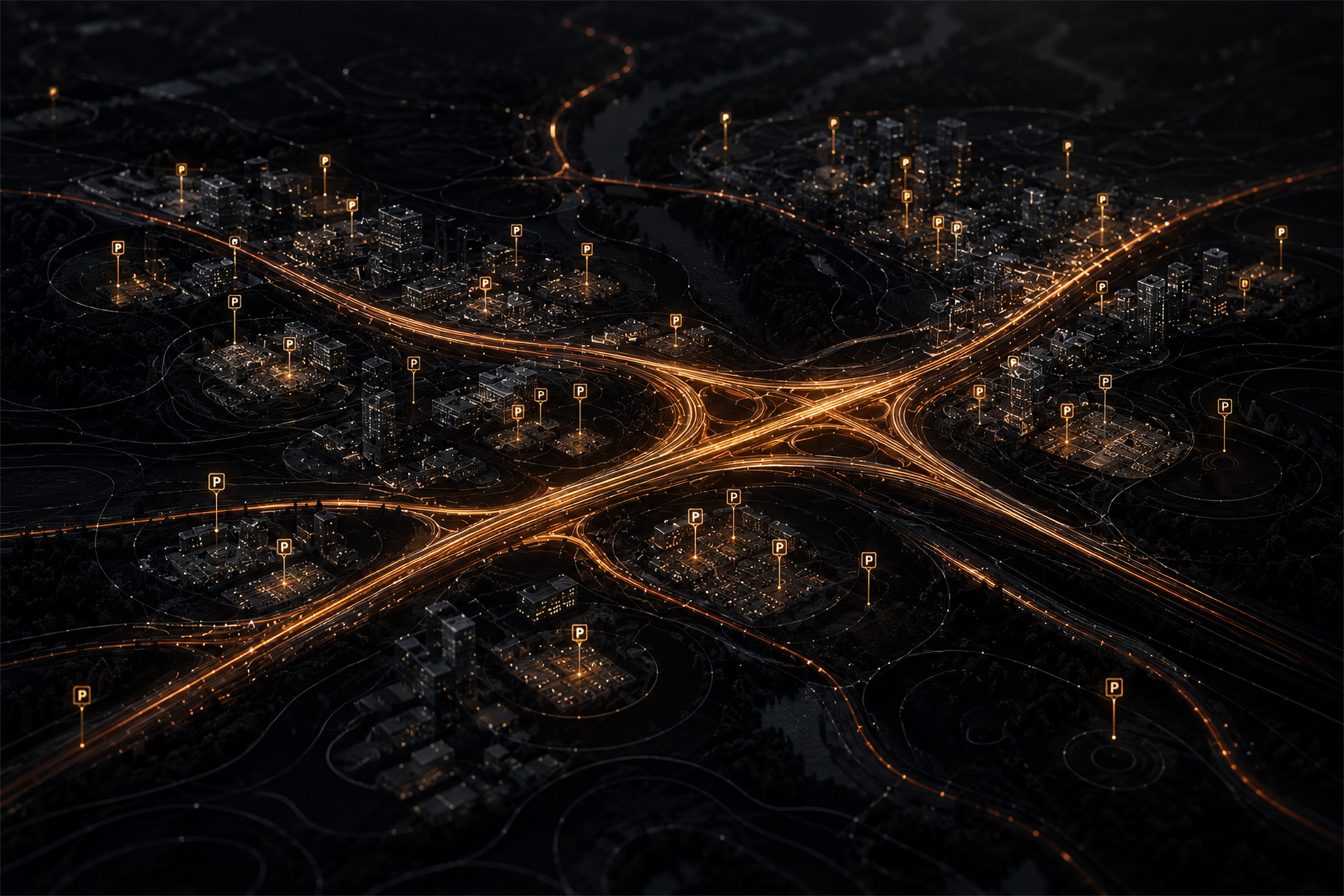
Mobility intelligence is the use of movement-related data and analytics to understand how people, vehicles and transport systems move through physical environments.
This information can come from different sources, including traffic sensors, connected vehicles, cameras, parking systems and other forms of location-based observation.
For businesses operating physical locations, mobility intelligence provides valuable context about how places are used.
It can help answer questions about vehicle arrivals, parking activity, repeat visits, dwell time and changes in demand.
Consider a retail destination.
Sales figures can show commercial performance. Mobility data can add another perspective by showing how vehicle activity around the destination develops over time.
Are more vehicles arriving? Are returning visits increasing? Is activity shifting towards different days or hours?
These observations do not explain every aspect of customer behaviour. Vehicle movements alone cannot establish which stores people enter or what they purchase.
But they can reveal changes that deserve attention and provide additional evidence for business decisions.
That is the value of mobility intelligence.
It makes movement measurable and helps businesses understand patterns in the physical environments they depend on.
What is decision intelligence?
Decision intelligence focuses on improving how organizations make decisions.
It brings together data, analytics, artificial intelligence and an understanding of business objectives to support the process of choosing what to do next.
Traditional business intelligence often helps organizations examine what has happened.
Decision intelligence goes further by connecting that understanding to possible actions, priorities and outcomes.
For example, a retail manager may already know that visits to a location have declined.
The more important questions are why activity has changed, whether the change requires attention and which actions are worth considering.
Should the team investigate accessibility? Review a local campaign? Compare the location with similar stores? Examine whether activity is shifting towards another destination?
Decision intelligence can help structure these questions and support a more informed choice.
It does not eliminate human judgment.
It gives the person responsible a stronger basis for making a decision.
How mobility intelligence supports better decisions
The connection between mobility intelligence and decision intelligence becomes particularly valuable when physical activity influences commercial or operational performance.
Retail location performance
Retailers need to understand which locations are performing well and where opportunities exist.
By examining vehicle arrivals, repeat visits and changes in activity, teams can identify patterns that complement sales and customer data.
A decline in vehicle traffic might suggest that a location deserves closer investigation.
Increasing repeat visits could indicate a changing pattern of destination usage.
When combined with other relevant information, these observations help teams decide where to focus their attention.
Marketing effectiveness
Marketing teams can measure digital impressions, clicks and online conversions.
Physical retail introduces another question.
Did activity around our locations change when the campaign was running?
Mobility intelligence can provide information about vehicle visits during different periods and across different locations.
Together with campaign data, sales figures and relevant comparisons, this can support a more informed evaluation of marketing performance.
It is important to distinguish correlation from causation. A change in arrivals does not automatically prove that marketing caused the change.
But having reliable observations about physical activity provides a stronger basis for investigation than relying on assumptions alone.
Property and parking operations
For property owners and parking operators, mobility intelligence can help reveal how facilities are used.
Understanding arrival patterns, occupancy, dwell time and changes in demand can support decisions about availability, parking conditions and operational resources.
Instead of making every decision based on isolated incidents or occasional observations, teams can examine patterns over longer periods.
This can help them identify where improvements may have the greatest practical value.
Expansion and investment planning
Choosing where to establish a new location involves substantial investment.
Demographics, local competition, accessibility and purchasing power all contribute to the decision.
Mobility intelligence can add observed movement patterns to that analysis.
When relevant datasets are combined, an expansion team can evaluate a potential location with a more complete picture of its surrounding activity.
The objective is not to replace established market research.
It is to strengthen it.
The role of AI in decision intelligence
Collecting and organizing data is only part of the challenge.
Organizations also need to interpret the information, recognize meaningful changes and understand which questions deserve attention.
AI can support this work by analyzing large volumes of information, identifying patterns and helping users explore possible explanations.
For example, an AI-supported analysis may highlight that vehicle activity at a location has changed significantly compared with previous periods.
It may help users compare locations, examine trends or generate a report explaining the observations.
More advanced systems may also support recommendations and automate selected operational processes when suitable controls and integrations are available.
But AI is not the objective.
A useful system should reduce the effort required to reach a well-informed decision.
The best outcome is not necessarily a more sophisticated dashboard.
It is a person who understands the situation and knows what to investigate or do next.
One source of intelligence. Different ways to use it.
Organizations have different levels of analytical capability.
A large retail chain may already have established business intelligence systems, dedicated analysts and extensive internal data.
For that organization, mobility data may be most valuable as an additional source of information that strengthens existing analysis.
Another business may prefer ready-made insights that explain what has changed and where attention is needed.
Both approaches can create value.
The important principle is that information should fit the organization’s decision-making process.
Businesses should not have to replace established systems simply to understand what is happening around their physical locations.
And they should not need specialist analytical teams to benefit from the information.
The purpose of intelligence is to make good decisions easier.
From understanding movement to improving outcomes
At Drifter, we see mobility intelligence as an opportunity to give businesses a clearer understanding of physical locations.
By combining vehicle movement data, real-world observations and AI, Drifter helps organizations analyze how locations are used and how activity changes.
Through Drifter Insights, this information can support location analysis and decision-making across retail, property management and parking operations.
The value is not limited to collecting data or presenting measurements.
It comes from connecting real-world information to the questions businesses already need to answer.
A location manager wants to understand performance.
A marketing team wants to evaluate results.
An expansion manager wants greater confidence before investing.
A parking operator wants to improve how available space is used.
Different decisions require different information, but they share the same fundamental need.
Clarity.
Mobility intelligence helps make the physical environment easier to understand.
Decision intelligence helps turn that understanding into better choices.
The goal is not more data. It is better decisions.